
The Performer
Performing for Love, Safety, and Belonging

Meet The Performer

The Performer Dragon learned early that attention felt safer than invisibility.
This dragon believes love must be earned, approval must be maintained, and worth is found in what you do rather than who you are. It often appears as charm, humor, achievement, perfectionism, over-functioning, or constantly being “on” around other people.
The Performer isn’t necessarily seeking validation in the same way as the Approval Seeker. Instead, this dragon is trying to secure connection by becoming whatever is most likely to be accepted, admired, appreciated, or applauded.
At first glance, this can look like confidence.
Underneath, it is often fear.
Fear of being overlooked.
Fear of disappointing others.
Fear that if the performance stops, the connection might disappear too.
Why This Dragon Exists
The Performer Dragon develops when being noticed, successful, entertaining, helpful, talented, or accomplished feels connected to receiving love, attention, or belonging.
Sometimes this happens in families where achievements are celebrated but emotions are ignored.
Sometimes it develops when children learn that being easy, funny, talented, or impressive creates positive attention.
Sometimes it forms because visibility feels safer than vulnerability.
Over time, the performance becomes a survival strategy.
The dragon isn’t trying to deceive anyone.
It’s trying to protect you.
How the Performer Shows Up
You may recognize this dragon if you:
- Feel pressure to always have it together.
- Struggle to show vulnerability.
- Use humor to avoid difficult emotions.
- Constantly achieve but rarely feel satisfied.
- Feel uncomfortable when you’re not productive.
- Find yourself performing different versions of yourself for different groups.
- Fear disappointing people.
- Tie your worth to accomplishments, recognition, or success.
- Feel exhausted from always being “on.”
The Performer often receives praise from the outside while feeling disconnected on the inside.
The Cost of Letting the Dragon Lead
The Performer Dragon can help you succeed.
It can help you inspire others.
It can help you create, lead, teach, and achieve.
But when it takes over completely, the performance becomes exhausting.
You may begin to lose sight of who you are underneath what you do.
Relationships can feel conditional.
Rest can feel uncomfortable.
Authenticity can feel risky.
And no amount of applause ever seems to fill the emptiness the dragon is trying to protect.
The more the Performer chases approval through performance, the harder it becomes to believe you are already enough.
Over time, this can lead to:
- Burnout
- Perfectionism
- Difficulty resting
- Fear of failure
- Overachievement
- Chronic busyness
- Emotional disconnection
- A loss of identity beyond what you do
When your value becomes tied to your performance, it can become difficult to separate who you are from what you achieve.
You begin chasing visibility through accomplishment while hiding the parts of yourself that simply want to be seen, accepted, and loved as you are.
Befriending the Performer
Healing isn’t about slaying the dragon.
It’s about understanding why they showed up to protect you in the first place.
The Performer has been carrying a heavy role for a very long time.
They learned that being impressive, successful, funny, capable, helpful, or entertaining could earn attention, connection, and belonging.
They genuinely believe that if they keep performing, no one will see the parts of you that feel vulnerable, messy, scared, or not enough.
Instead of fighting them, try getting curious.
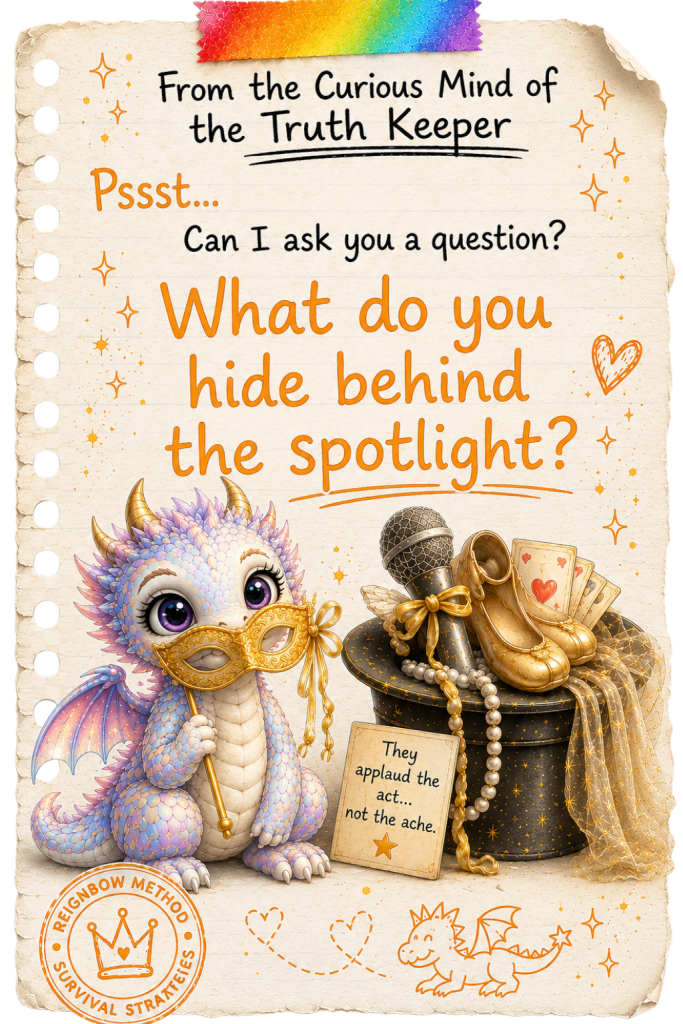
Take a Moment to Reflect…
- What am I hoping this performance will protect me from?
- Who taught me that being myself wasn’t enough?
- What feels risky about being seen without achieving, producing, or impressing?
- When did I learn that love had to be earned through performance?
- What emotions am I avoiding by staying busy, successful, or “on” all the time?
- Who am I when there is no audience?
Compassion often reveals what perfection never could.
Reclaiming the Treasure
Jewel Reclaimed 💎: Visibility
The treasure hidden beneath the Performer Dragon is authenticity.
The realization that your worth is not something you earn.
It is something you already possess.
When the Performer begins to relax, you no longer need to prove your value every day.
You can create because you love creating.
You can share because you have something meaningful to say.
You can rest without guilt.
You can be seen without performing.
The goal is not to eliminate the Performer.
The goal is to help the dragon understand that connection does not require a constant performance.
Get Curious Like the Truth Keeper…
There are no right or wrong answers here. Just notice what comes up.
Reflection Questions
What is this dragon helping you to see?
Who am I when no one is watching?
What am I trying to earn through achievement, success, or recognition?
Where did I learn that being impressive was safer than being authentic?
What would happen if I stopped performing for a moment?
What parts of myself only emerge
when I feel completely safe?
✨ What part of yourself has been waiting
behind the spotlight all along?
When you’re ready… keep reading. The Wisdom Keeper has something they would like you to remember.
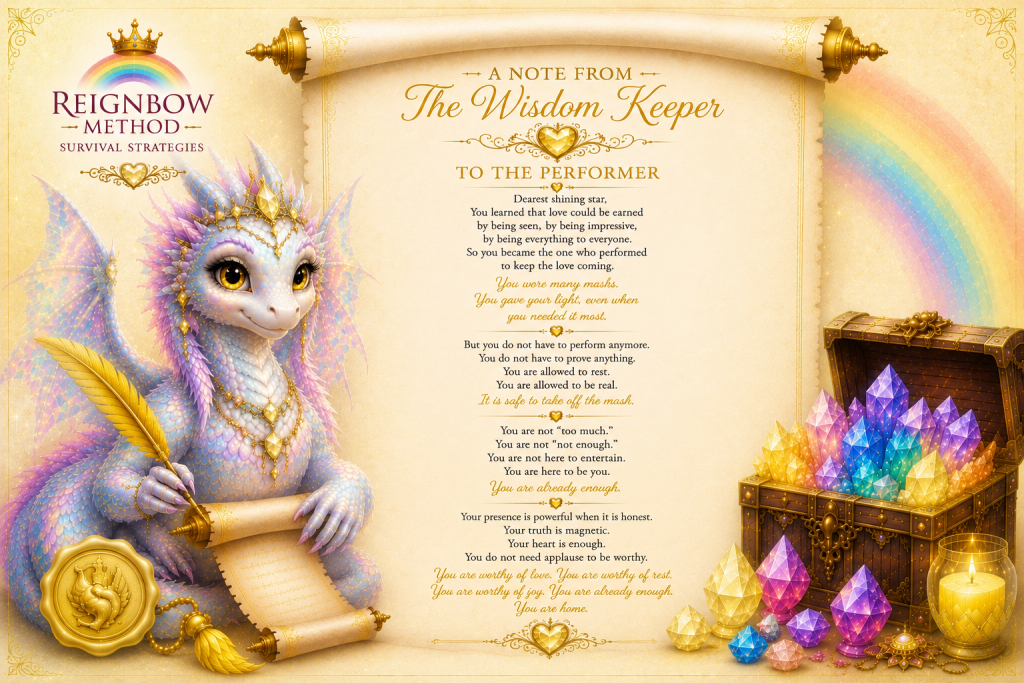
A Note From the Wisdom Keeper
You were never meant to earn your place in the world through performance.
The Performer learned that being impressive, helpful, successful, entertaining, or strong could bring connection, attention, and belonging. They stepped onto the stage because they believed it was the safest place to stand.
But you are more than what you produce.
More than what you achieve.
More than what you accomplish for others.
The people who truly see you are not looking for a performance. They are looking for you.
The parts of yourself that feel tired, uncertain, emotional, imperfect, or unfinished are not flaws to hide. They are part of what makes you human.
You do not have to keep proving your worth.
You do not have to earn your right to take up space.
You do not have to perform your way into love.
The moment you allow yourself to be seen as you are is the moment you begin reclaiming the visibility that was yours all along.
With love,
The Wisdom Keeper 🐉💜

You Are the
Treasure.
The dragons helped you survive.
Now it’s time to reclaim what has always been yours.
Reclaim Your REIGNBOW
MEET THE OTHER DRAGONS
CONNECT THE DOTS
If this dragon feels familiar, it rarely travels alone.
The Performer is part of a larger survival pattern — one where identity gets built through being seen, being needed, and being “good at something.”
You might also recognize these patterns nearby:
The Approval Seeker
“Tell me I’m enough.”
Looks for validation through reflection, reactions, feedback, and approval of others.
Connection: Where the Performer seeks achievement, The Approval Seeker seeks affirmation.

The Dependent
“Don’t let me do this alone.”
Looks for safety through connection, support, and the presence of others.
Connection: Where the Performer earns love through achievement, the Dependent seeks safety through attachment.

The Controller
“If I manage everything, nothing falls apart.”
Looks for safety through structure, certainty and control over outcomes.
Connection: Where the Performer seeks approval, the Controller seeks stability through direction.
The Pattern Behind It All
These dragons rarely travel alone.
What looks like one survival strategy is often connected to several others, each trying to solve the same problem in a different way.
One dragon may seek approval. Another may strive to achieve. Another may cling tightly to connection or try to control what happens next.
Beneath each strategy is the same desire:
To feel safe. To belong. To be loved.
If one dragon feels familiar, there’s a good chance others are flying nearby.
The Performer often travels alongside the Approval Seeker, the Controller, and the Dependent, each searching for safety, worth, or belonging in their own way.